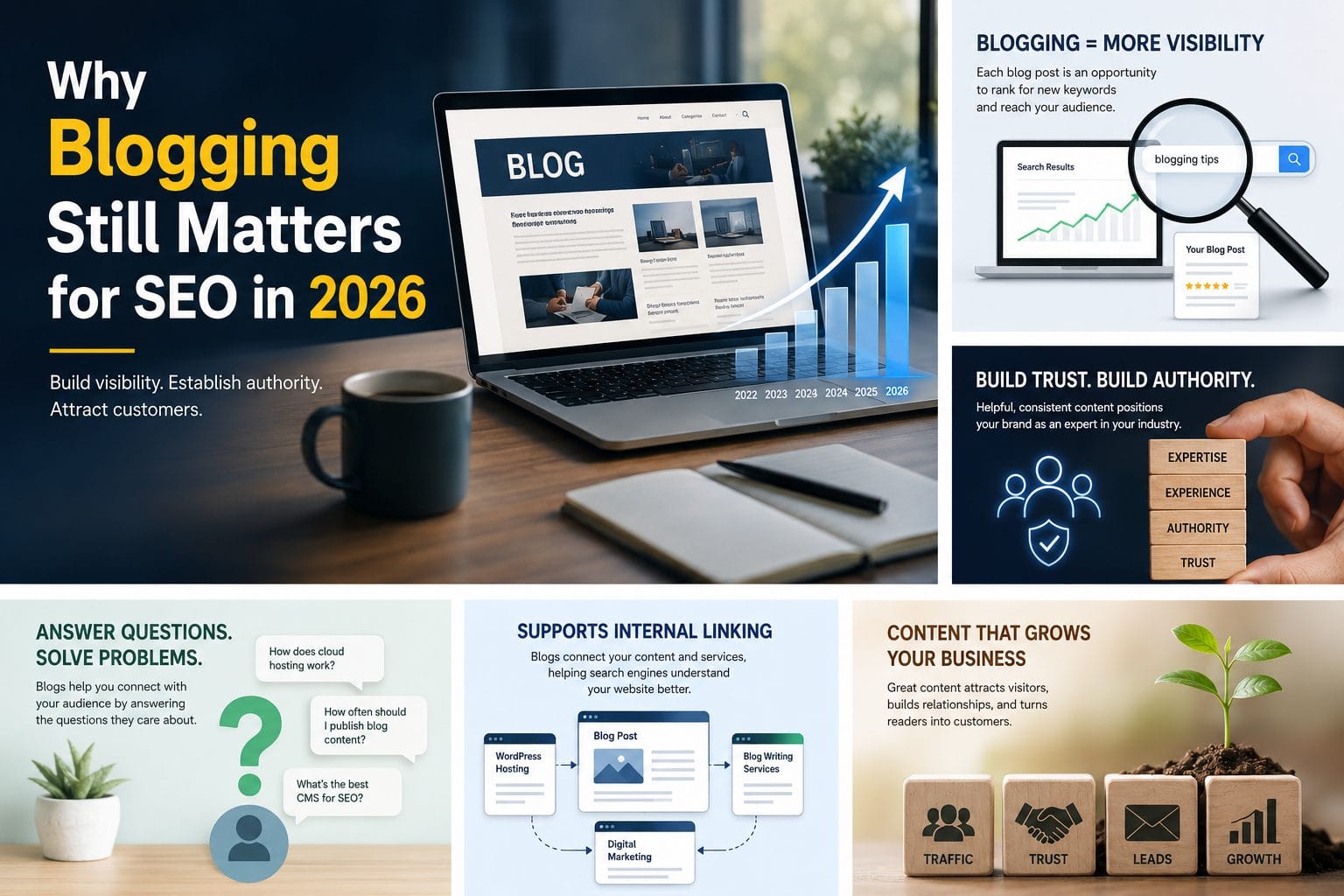
Why Blogging Still Matters for SEO in 2026
Blogging Still Matters – Even in the Age of AI
In the age of artificial intelligence and the constantly evolving search algorithms, business leaders wonder if traditional blogging still matters. The answer, dear readers, is a big YES! Despite the dominance of AI and newer digital marketing channels, blogging is still one of the primary ways to enhance search engine visibility, establish authority, and attract potential customers.
However, in 2026, blogging is not just about publishing articles for the sake of creating content. Blogging has now become a strategic tool that aids businesses to prove expertise, answer customer queries, and simultaneously build trust among search engines and human readers.
Blog posts are valued for their informative and helpful content that makes the user’s journey simple. The more helpful the content is, the better for the users, especially those who need to decide.
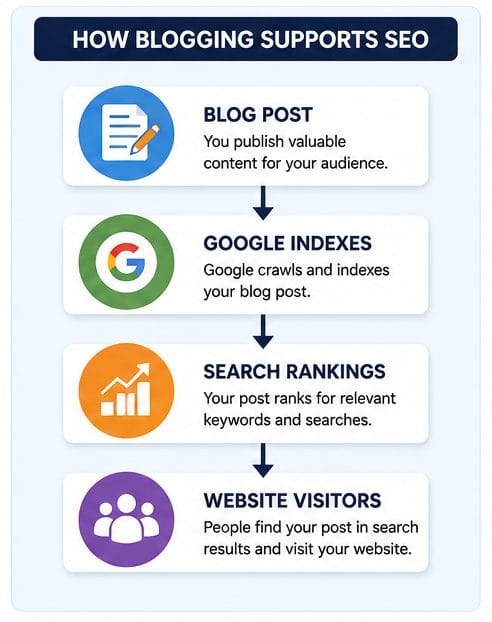
How Blogging Supports SEO
Search engines are designed to help users by providing relevant and useful information. Blogs are a platform businesses use to create content that answers specific questions and addresses the trials and benefits their target audience faces.
Every well-written blog post only creates an additional opportunity for your website to appear in search engine results pages (SERP). Rather than relying merely on your service pages, blogging allows you to target a wide range of keywords and search queries.
For example, a business that offers blog writing services may have a service page optimized for “blog writing services,” while a supporting article such as “Why Blogging Still Matters for SEO in 2026” can appeal to visitors searching for information about blogging and SEO.
This kind of broad content strategy can help you increase organic visibility and, at the same time, drive more qualified traffic to your website.
Therefore, blogging still matters for SEO in 2026 and will continue to help businesses appear in organic and AI-system search results.
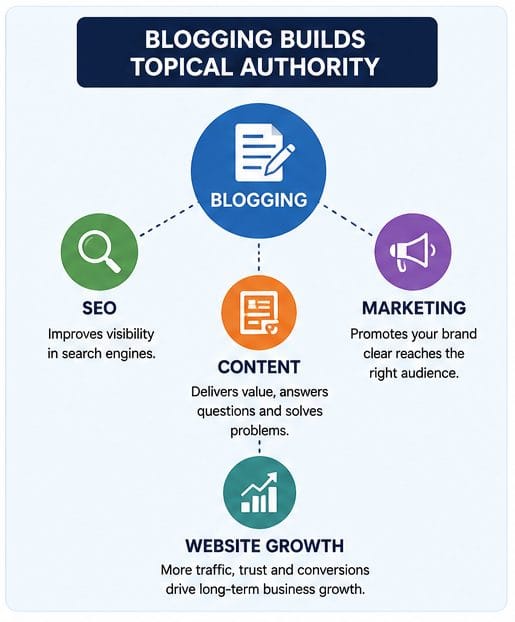
Blogging Builds Topical Authority
Search engines progressively evaluate websites based on their depth of knowledge within a specific subject area. By publishing high-quality blog content, you consistently demonstrate that your business recognizes its industry and can provide valuable insights.
When your website includes multiple articles covering related topics, search engines naturally gain a clearer insight into your expertise. It helps prove beyond doubt your grasp of the subject of content marketing.
For example, a content marketing website might publish articles on:
- Blogging for SEO
- Content marketing strategies
- AI-generated content
- Keyword research
- Website copywriting
Collectively, these articles create a topical cluster that emphasizes the website’s authority in content marketing.
Over time, this can improve rankings across a wider range of search terms, which again tells us that blogging still matters!
Fresh Content Signals Relevance
While search engines do not reward websites just for publishing content regularly, they certainly value websites that remain active and relevant. The content should be informative and should add value to the users who seek to know more about the concerned topic.
Therefore, regular blogging allows businesses to:
- Address emerging industry trends
- Update customers about new developments
- Answer common questions
- Expand existing content topics
Fresh content proves that a website is actively maintained, which can positively influence user trust and search engine perception. It adds value in terms of timely updates.
Furthermore, this becomes important in fast-growing industries.
Blogs Help Answer Customer Questions
Most people start their buying journey with a question. They want to know more about the product or service, if it is suitable for them, and if it is worth buying. They want to glean all the information before finally deciding to buy.
Relevant examples include:
- What is cloud hosting?
- How often should businesses publish blog content?
- What makes a great logo design?
- Why is website speed important for SEO?
A blog allows businesses to answer these questions directly and to the user’s satisfaction.
When users find helpful and valuable information on your website, they are more likely to view your business as a trustworthy source of expertise. This trust often translates into inquiries, consultations, and eventually, sales.
That is why blogging still matters, provided the content positively helps users, giving valuable information.
Blogging Supports Internal Linking
Internal links play a major role in SEO by helping search engines understand the structure of your website. Blog posts provide opportunities to link naturally to relevant service pages, making the user’s journey easier and satisfying the search engines as well.
For instance, an article discussing content marketing can link to your Blog Writing Services
page. Similarly, an article about website performance can link to your Cloud Hosting or VPS Hosting Services.
These connections strengthen your website’s overall architecture and help distribute authority across important pages. It provides seamless connectivity across pages, which helps in easier mapping across your website for search engines.
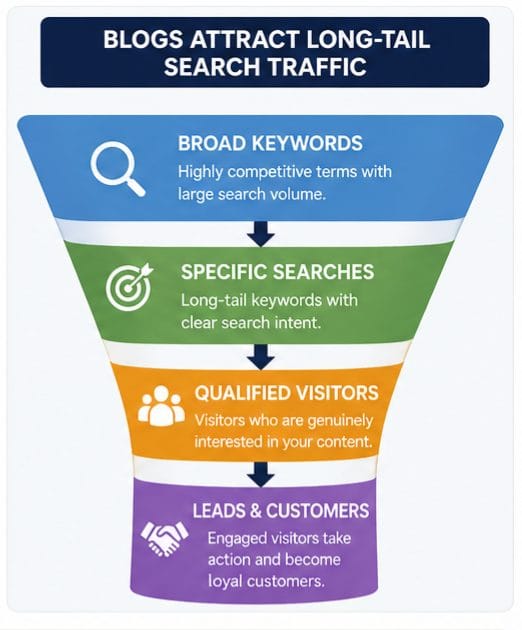
Blogs Attract Long-Tail Search Traffic
Many users search for highly specific phrases rather than broad keywords.
Examples include:
- How often should a small business publish blog posts?
- Does blogging help local SEO?
- Is AI content good for search rankings?
These longer, more detailed searches are known as long-tail keywords.
Blog articles effectively target these queries by allowing detailed explanations and practical guidance.
Although individual long-tail keywords may generate lower search volume, they often attract visitors with stronger intent and a greater likelihood of converting into customers.
Blogging Enhances AI Search Visibility
The way people discover information online is constantly changing. For example, AI-powered searches increasingly summarize and recommend content from trusted sources.
Therefore, businesses that publish clear, informative, and well-structured articles have better chances of being found and referenced by AI systems.
Articles that generally provide direct answers and practical advice, along with authoritative information, are more likely to surface in AI-generated responses.
This makes blogging not only relevant for traditional SEO but also for the future of AI-assisted search.
Common Blogging Mistakes to Avoid
While blogging is still valuable, not all blog content delivers results unless they are targeted at AI systems
Some common mistakes include:
Publishing Low-Quality Content
Thin articles with hardly any useful information seldom perform well.
Ignoring Search Intent
Content should try to address what users are actually searching for rather than focusing merely on keywords.
Inconsistent Publishing
A blog that is abandoned for months at a time will generally struggle to build momentum.
Neglecting Internal Links
Every article should guide readers toward related content and relevant service pages.
Writing for Search Engines Instead of People
The best-performing content generally balances SEO best practices with genuine value for readers.
Frequently Asked Questions
Does blogging still help SEO in 2026?
Yes. Blogging is still one of the most effective ways to increase organic visibility, target additional keywords, and demonstrate expertise.
How often should businesses publish blog content?
Quality matters more than quantity. For many businesses, publishing one to four high-quality articles per month is sufficient.
Can blogging generate leads?
Absolutely. Helpful blog content attracts potential customers, builds trust, and encourages visitors to explore your services.
Is AI-generated content replacing blogs?
No. AI can assist with content creation, but businesses still benefit from publishing original, insightful, and authoritative blog content.
How long should a blog post be for SEO?
There is no such thing as perfect length. The best articles are comprehensive enough to satisfy user intent while remaining clear and engaging.
Conclusion
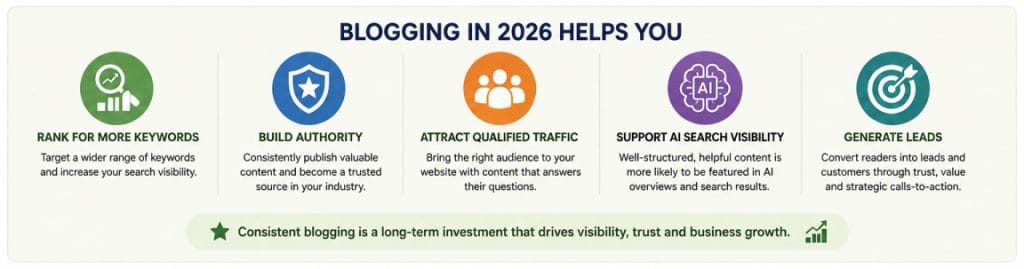
Despite the rapid evolution of digital marketing, blogging is still a powerful tool for SEO in 2026. It helps businesses expand their search visibility, build authority, answer customer questions, and support broader marketing goals.
Rather than viewing blogging as an outdated tactic, businesses should see it as a long-term investment in online visibility and credibility. A consistent publishing strategy, combined with high-quality content and strong internal linking, can continue to drive meaningful traffic and business growth for years to come.