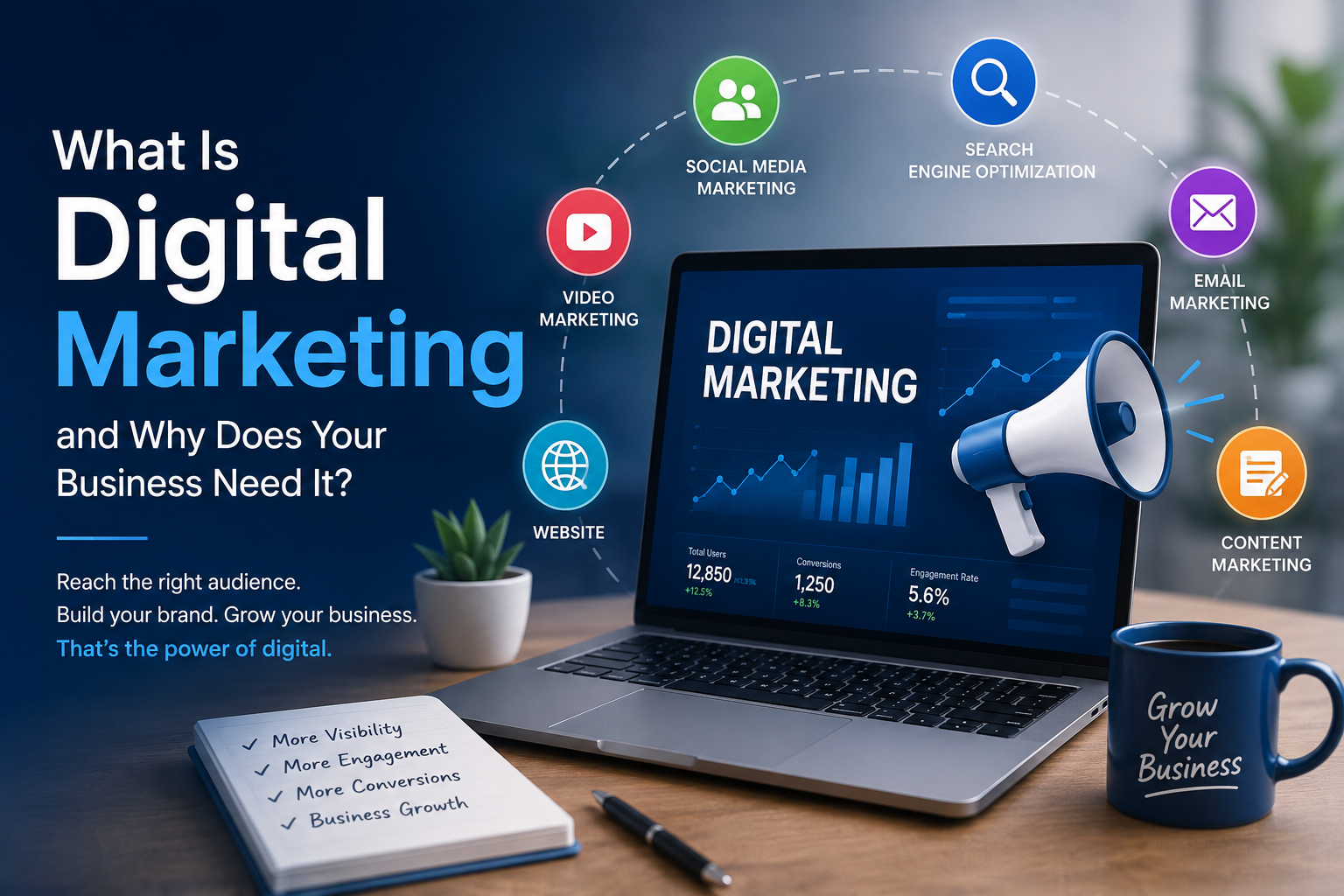
What Is Digital Marketing and Why Does Your Business Need It?
What Is Digital Marketing?
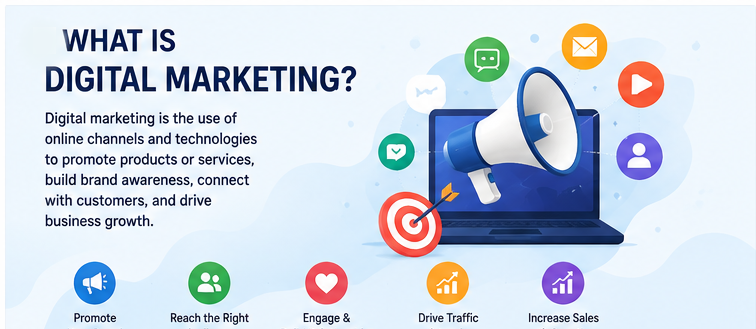
Digital marketing for businesses involves the promotion of a business through digital channels. It could be a specific brand, a product, or a service.
The digital channels may include:
- Search engines
- Websites
- Blogs
- Social media
- Video platforms
- Online advertising
- Online directories
- Business profiles
Unlike conventional advertising, digital marketing for businesses allows a business to reach its targeted audience where they are already present and actively seeking information.
For instance, someone who searches for “professional logo design for a small business” on Google is already showing interest in that service. A well-designed and optimized website can present your logo design business to that person at the perfect stage of their needs. This is a win-win situation for both buyer and seller.
This is the basic advantage of digital marketing: being discoverable when people are looking for your specific product or service.
Why Does Digital Marketing Matter?
The way people research, discover, compare, and purchase products and services has changed dramatically in recent times. This change can be attributed to the enormous advancement in technology.
Potential customers may find your business through a search engine such as Google or Bing. They may discover and read one of your blog articles, visit your website, and see your social media profile. They may even get to compare your services with those of your competitor, and eventually contact you some days later.
All these interactions may happen across several different channels.
What digital marketing for businesses does is allow you to participate in that entire journey. It allows you to use multiple channels rather than depending on a single advertisement or point of contact.
Therefore, a strong digital presence can help your business:
- Increase online visibility
- Influence the right audience
- Establish trustworthiness
- Generate website traffic
- Build relationships with possible customers
- Generate enquiries and leads
- Encourage repeat business
- Measure marketing performance
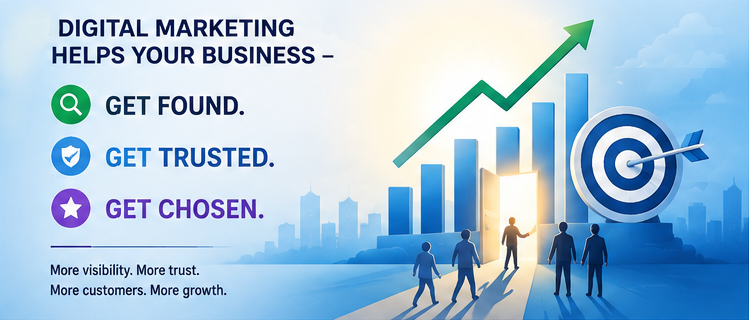
The objective of digital marketing isn’t simply to “be online.”
It is to establish a digital presence that helps people find you, understand you, trust you, and eventually choose you.
The Key Components of Digital Marketing
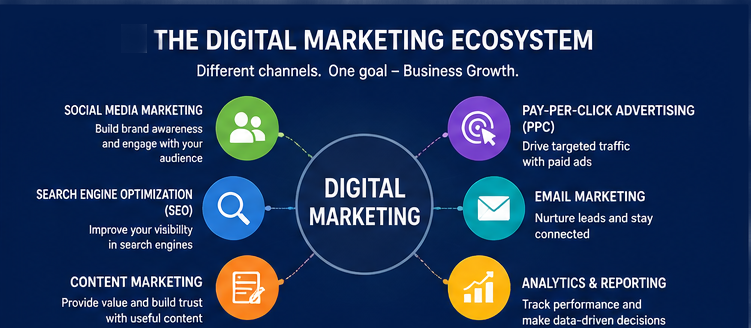
Digital marketing for businesses isn’t just a single activity. It encompasses a whole ecosystem of connected strategies. These strategies include:
1. Search Engine Optimization (SEO)
Search Engine Optimization is essential to help your website become more visible. SEO plays an important role when people search for relevant information regarding products or services online.
SEO strategy involves:
- Keyword and search-intent research
- Useful website content
- Technical optimization
- Internal linking of content
- Great page experience
- Systematically structured data
- Content organization
- Authority and reputation building
For example, a web design company will have a service page for Website Design. The company may support that page with articles explaining responsive design, website usability, mobile-first design, and website performance.
While the service page targets commercial searches, the supporting content goes on to helpfully answer relevant questions.
Together, these pages create a stronger search presence.
Options Global Tip:
Don’t ever think of SEO as something you “add” to your website after it is built. Positive results happen when you consider search visibility in the larger context—as part of the website, content, and marketing strategy. Right from the beginning.
2. Content Marketing
Content marketing is the strategy of creating useful information that not only attracts your target audience but educates them, too. This helps the user make an informed decision when it matters.
Content marketing strategies could include:
- Blog articles
- Case studies
- Tutorials
- Guides
- Infographics
- Videos
- Checklists
- FAQs
Good content should answer questions that potential customers already have on their minds.
For example, a hosting company might publish: “How to Choose the Right Reseller Hosting Plan“
Someone looking for that information may not yet be ready to purchase, but they are definitely interested in hosting.
When you provide helpful and valuable content, it allows the business to demonstrate its expertise. This helps to begin building a relationship with that potential customer.
This is also the reason a robust business blog should not consist of random articles. Content on your blog should support the services you offer while forming meaningful topical connections across your website.
3. Website Design
Your website is usually the epicenter of your digital marketing strategy.
You can attract thousands of visitors to your website. However, if it is slow, confusing, difficult to use, or poorly presented, those visitors may leave without taking any action.
Therefore, a good business website should:
- Clearly explain what you offer
- Establish trustworthiness
- Load quickly and efficiently
- Work well on mobile devices
- Make navigation easy
- Provide clear calls to action
- Be easy for visitors to contact you
Most of all, your website should reflect your brand identity.
That is why logo design, website design, content, and digital marketing should not be treated as completely separate activities.
They work best when they support one another. Together, they spell success.
4. Social Media Marketing
Social media provides businesses with opportunities to communicate directly with their audiences, anywhere in the world.
Depending on your industry and customers, this might involve platforms such as:
- X
- YouTube
- Other industry-specific platforms
Social media can help businesses:
- Increase brand awareness
- Share useful content and insights
- Demonstrate expertise
- Engage with customers
- Promote products and services
- Build communities
However, being active on every available social platform isn’t necessary.
The smart approach is to identify where your audience actually spends time and concentrate your efforts there.
5. Email Marketing
Even in these times, email marketing remains a valuable way to maintain relationships with people. Especially with those who have already shown an interest in your business.
Email can be used for:
- Newsletters
- Product announcements
- Special offers
- Educational content
- Follow-ups
- Customer retention
Unlike social media, where algorithms influence who sees your content, an email list gives you a more direct communication channel. You can use this channel to communicate with people who have subscribed to your website or newsletters.
The motive is to provide value through the emails rather than simply sending promotional messages.
6. Online Advertising
Paid digital advertising allows businesses to reach specific audiences through different platforms. These include search engines, social networks, and other professional and advertising networks.
Depending on the campaign, you can target audiences based on factors such as:
- Search behavior
- Location
- Interests
- Demographics
- Previous interactions with your website
Paid advertising definitely provides quick visibility, but it requires thoughtful planning.
A paid campaign can generate plenty of traffic without generating meaningful business. The key is to get the landing page, targeting, offer, and follow-up process right.
How Digital Marketing Components Work Together
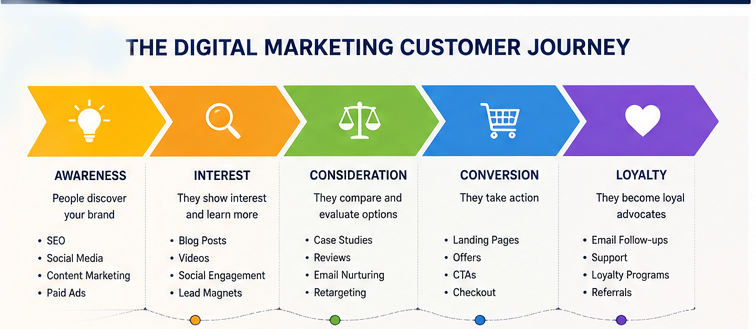
The real power of digital marketing can be realized when the different components support one another seamlessly.
Consider this simple example:
A potential customer searches online for information about website design.
↓
They discover a helpful blog article on your website.
↓
The article introduces them to your business and links to your Website Design service.
↓
They explore your website and discover examples of your work.
↓
They follow your business on social media or subscribe to your newsletter.
↓
Later, they return to your website when they are ready to request a quotation and
want to make use of your service.
Here, no single marketing channel created that customer.
The entire digital ecosystem worked together.
This is why digital marketing for businesses should be viewed as a totally connected system rather than a collection of unrelated tactics.
Digital Marketing for Small Businesses
Digital marketing isn’t the domain of only large corporations with enormous advertising budgets.
It can be hugely valuable for small businesses as well. Especially so, because digital channels allow you to focus your resources on specific audiences and measurable objectives.
A small business might begin with:
A Professional Website
The first logical step is a well-built website. Your website establishes your digital home and provides a destination for potential customers.
Local SEO
If you serve a particular geographic area, the primary task is optimizing your online presence for relevant local searches. This way, you can help nearby customers discover you.
Helpful Content
Publishing useful articles allows you to answer customer questions and demonstrate your proficiency.
Consistent Branding
A professional logo, visual identity, and consistent messaging will, over time, make your business recognizable.
Social Media
Choose social media platforms that are genuinely relevant to your audience rather than trying to maintain a presence across all platforms. This way, you can stay more focused.
Measurement
Track only meaningful outcomes rather than vanity metrics.
This structured approach allows even a small business to build its digital presence progressively. On the other hand, trying to do everything at once may not be successful
Organic vs Paid Digital Marketing
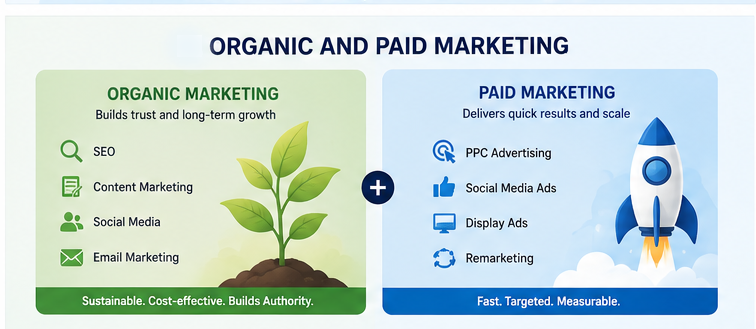
Digital marketing for businesses can broadly be separated into organic and paid marketing activities.
Organic Marketing | Paid Marketing |
SEO | Search advertising |
Blog content | Social media advertising |
Organic social media | Display advertising |
Email marketing | Sponsored content |
Long-term visibility | Faster visibility |
Organic search visibility | Pay-per-click campaigns |
However, neither approach can be termed as automatically better.
Organic strategies build sustainable visibility over time, while paid campaigns provide immediate results and help test offers and audiences.
For many businesses, the most effective approach is a combination of both.
How to Build Your Digital Marketing Strategy
A successful strategy should start with your business objectives—not with a particular social media platform or advertising tool. Thoughtful planning and implementation go a long way toward the success of any campaign.
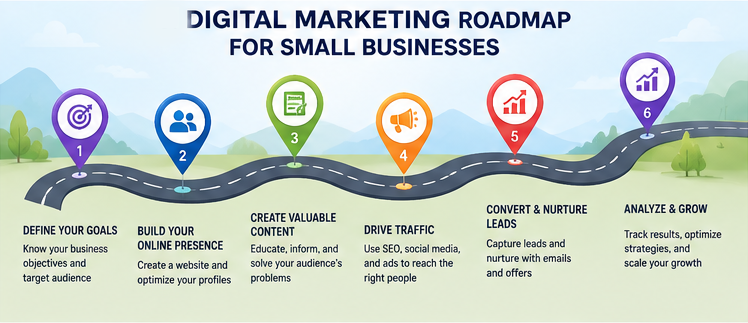
Step 1: Define Your Goals
What are you trying to achieve?
For example:
- Increase enquiries
- Generate leads
- Sell products
- Build brand awareness
- Increase website traffic
- Retain existing customers
Your goals will determine which channels and metrics matter most.
Step 2: Understand Your Audience
Identify:
- Who your customers are
- What problems they have
- What they are searching for
- What influences their decisions
- Where they look for information
The better you understand your audience, the more relevant your marketing will be.
Step 3: Fortify and Secure Your Website
Before you send large amounts of traffic to your website, make sure it provides a good experience and can withstand the rush. It must be primed to handle sudden surges in traffic.
Check:
- Page loading speed
- Navigation ease
- Mobile usability
- Content quality
- Calls to action
- Contact options
- Trust signals
A bad user experience or failure to handle traffic could see your efforts go in vain, so prepare well beforehand.
Step 4: Create Useful Content
Develop content around the questions your audience is likely to ask and ensure it provides valuable information rather than half-baked answers.
A strong content strategy should back your commercial services and not exist independently of them.
Step 5: Choose the Right Channels
You don’t necessarily need to be on all the available channels.
Only choose the ones most likely to reach your customers and execute them well.
Step 6: Measure and Improve
Digital marketing for businesses is definitely not a “set it and forget it” exercise. It is much more than that and needs a lot of patience and care.
Review your results, identify what is working, improve what isn’t, and continue refining and optimizing your strategy regularly.
Common Digital Marketing Mistakes
Businesses that invest heavily in digital marketing can make avoidable mistakes, too. It pays to know how to avoid those mistakes, so you have a better experience.
Trying to Do Everything
Maintaining a large number of social media accounts will become difficult, although it could be tempting to do so. Publishing daily, running advertisements, managing email campaigns, and writing blogs can very quickly become unsustainable. Therefore, choose wisely and execute smartly.
Focus only on the channels that matter.
Chasing Vanity Metrics
Number of followers, “likes”, and impressions can be useful indicators, but they aren’t the same as business results.
A smaller audience that generates more enquiries is far more valuable than a large, friendly audience that never converts.
Ignoring the Website
Digital marketing campaigns eventually need someplace to send people. Ideally, it is your website.
However, if your website provides a poor user experience, increasing traffic won’t solve the underlying problem.
Publishing Content Without a Strategy
Creating articles simply because you need to post a blog every week will not produce meaningful results.
Every article published should have a purpose, and it should be well addressed.
Expecting Immediate SEO Results
SEO and content marketing generally require a lot of patience. You don’t get to see results overnight. Remember, SEO is important and is effective, but it takes time.
Strong content can continue attracting visitors long after publication, making it a long-term investment rather than a short-term campaign.
Focusing Only on Acquisition
Winning new customers is, of course, important, but retaining existing customers is equally valuable.
Digital marketing for businesses should support the entire customer relationship—not just the first interaction.
How Do You Measure Digital Marketing Success?
The right metrics always depend on your objectives.
For example:
Awareness
- Search impressions
- Reach
- Brand searches
- Website visibility
Engagement
- Time spent on important pages
- Content engagement
- Email engagement
- Returning visitors
Lead Generation
- Enquiries
- Contact-form submissions
- Calls
- Consultation requests
Sales
- Purchases
- Revenue
- Conversion rate
- Customer acquisition cost
It is important to connect marketing activity to meaningful business outcomes.
A campaign that generates about 10,000 visitors but zero enquiries is less successful than one that generates only 500 visitors but 20 qualified leads.
Digital Marketing for Businesses in the Age of AI Search
Search has evolved and is constantly undergoing change with the advent of AI.
Users increasingly use AI-powered search to ask longer, more conversational questions and explore topics from different angles.
However, that doesn’t make traditional SEO obsolete. In fact, it reinforces it. Google’s current guidance says its generative AI search experiences continue to rely on core Search systems. It emphasizes original, useful, people-first content and technically accessible websites.
For all businesses, this means the fundamentals still matter:
- Create genuinely useful content.
- Establish real expertise.
- Organize information clearly.
- Keep your website glitch-free and technically accessible.
- Use relevant, high-quality images.
- Answer customer questions meticulously.
- Build a coherent body of content around your areas of expertise.
In other words, digital marketing for businesses is becoming more integrated, not less important.
Your website, content, branding, SEO, and customer experience all contribute to how your business is discovered and understood.
Frequently Asked Questions
What is digital marketing in simple terms?
Digital marketing for businesses is the process of promoting your business through digital channels such as search engines, websites, social media, email, online advertising, and digital content.
Why is digital marketing important for small businesses?
It helps small businesses become more visible, reach specific audiences, demonstrate expertise, generate enquiries, and compete with larger businesses online.
What are the main types of digital marketing?
The major areas include SEO, content marketing, website marketing, social media marketing, email marketing, and paid online advertising.
Which digital marketing strategy is best?
There is no single strategy that can be termed best for a business. The best approach depends on your audience, objectives, industry, budget, and resources. Different strategies work for different businesses.
How long does digital marketing for businesses take to work?
Some marketing activities, particularly paid advertising, can produce visibility quickly. SEO, content marketing, and organic brand building generally require more time and consistency. They are fruitful over longer periods and last longer, too.
Can a small business do digital marketing itself?
Yes. Businesses can definitely manage many digital marketing activities internally. However, professional assistance can be valuable when specialist knowledge, strategy, design, SEO, content, or technical expertise is required.
Is SEO still important with AI search?
Yes. Google’s current guidance explicitly states that SEO best practices remain relevant to its generative AI search experiences. This is because those experiences are grounded in its core Search systems. (Google for Developers)
Final Thoughts
Digital marketing for businesses doesn’t mean simply posting on social media, ranking on Google, or running online advertisements.
It is about creating a connected digital presence. This will help your business get discovered, communicate its value, build trust, and turn attention into meaningful business relationships.
For a business to be successful today, your website, content, branding, SEO, social presence, and customer communications should work together. That is when it all gels together to make the campaign successful.
One should remember that the businesses that benefit most from digital marketing are not necessarily those that spend the most. The really successful ones are those that understand their audience, choose the right channels, provide genuine value, and measure meaningful outcomes. All these, along with regular improvements, are a must to succeed.
Digital marketing for businesses is, therefore, not just another promotional activity.
It is an essential part of how a modern business builds visibility, credibility, relationships, and sustainable growth.
Are You Ready to Strengthen Your Digital Presence?
A successful digital marketing strategy for growing brands starts with a strong foundation: a professional website, clear branding, useful content, and a plan built around your business goals.
If you’re looking to enhance your online visibility and turn your digital presence into a stronger business asset, Options Global can help. We can bring these elements together through website design, digital marketing, content, branding, and hosting solutions. We can help you reach the summit in your segment and, more importantly, stay there.